

New Cochrane Review Questions Alzheimer’s Drugs; Czech Company Unveils Alternative
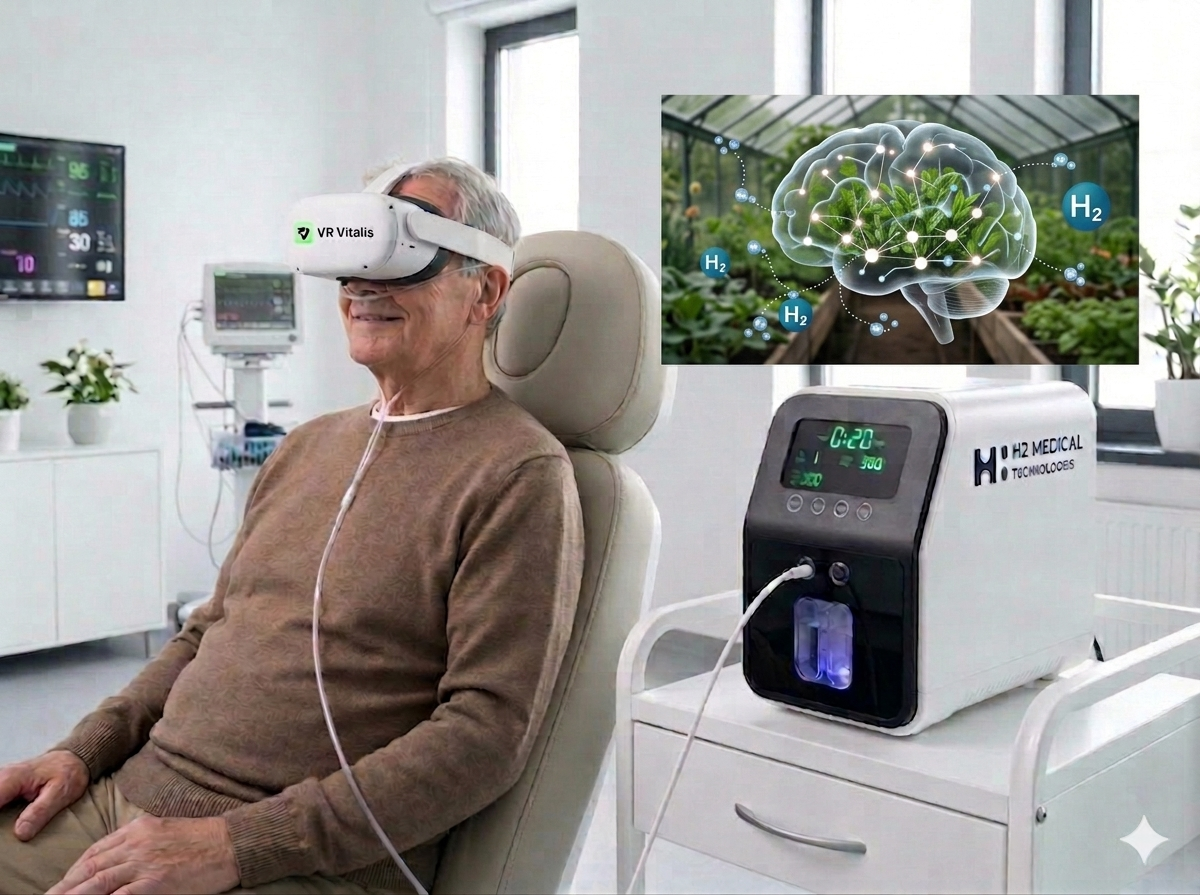
A patient undergoes combined molecular hydrogen inhalation and VR cognitive rehabilitation — a dual-therapy approach developed by H2 Global Group and VR Vitalis for Alzheimer's and dementia treatment.
The latest Cochrane review finds “trivial” clinical benefits in new Alzheimer’s drugs - European innovator proposes a patented solution using molecular hydrogen
On April 16, 2026, Cochrane published a systematic review of anti-amyloid monoclonal antibodies in patients with mild cognitive impairment and mild dementia due to Alzheimer’s disease. The analysis aggregated data from 17 clinical trials involving over 20,000 participants. According to the authors, the effect of these drugs is merely “trivial,” falling short of clinically meaningful benefit. The review also highlights increased incidence of brain swelling and microhemorrhages (ARIA).
Lead author Francesco Nonino of the IRCCS Institute of Neurological Sciences in Bologna stated that these drugs do not provide a meaningful clinical difference. The authors emphasize that future Alzheimer’s research must pivot toward alternative mechanisms of action.
Global Media and Experts React
The Guardian called the effect “trivial,” The New York Times detailed the fierce debate over clinical value, the BBC noted patients are unlikely to benefit, and Scientific American found the clinical difference “absent or trivial.” The UK’s Mirror referred to the “bombshell” finding that these medicines do not work.
Professor Robert Howard (University College London) expressed that the effects had been presented too optimistically to patients’ families. Professor Paresh Malhotra (Imperial College London) cautioned that research must look beyond the amyloid pathway.
Annual treatment costs hover around €77,000 ($82,000 USD) per patient, a key reason why several European nations face reimbursement hurdles for these drugs.
The European Response: Molecular Hydrogen and VR
H2 Global Group dispatched a strategic proposal to all 27 EU leaders on April 17, centering on the combination of molecular hydrogen therapy and VR cognitive rehabilitation developed with a portfolio VR company, whose solution is already a certified medical device (MDR) deployed in over 40 European hospitals.
PharmDr. Milan Krajíček, Chief Medical Officer at H2 Global Group, notes that an exclusive focus on beta-amyloid is unlikely to solve the disease. The company advances an approach targeting oxidative stress and neuroinflammation alongside neurodegeneration.
Its strategy is anchored in the patent “Prophylactic or Therapeutic Agent for Dementia” (EP 3701956 B1), being expanded globally including the US. It protects the use of gaseous hydrogen in Alzheimer’s-type dementia, including cases where standard treatments have failed, and covers preventative use in early cognitive decline. The scientific foundation was laid by Professor Shigeo Ohta of Nippon Medical School, whose landmark 2007 Nature Medicine study demonstrated hydrogen’s therapeutic antioxidant effects. Subsequent studies confirmed its neuroprotective properties in dementia.
In January 2026, the firm launched a clinical study approved by SÚKL and the Ethics Committee of University Hospital Ostrava, aiming to register a unique medical device utilizing molecular hydrogen.
“With molecular hydrogen, we address the ‘hardware’ of the brain, clearing inflammation and oxidative stress. Virtual reality acts as the ‘software’, stimulating neuroplasticity. It is a powerful synergistic effect,” explains Dr. Krajíček.
A Paradigm Shift in Cost and Accessibility
“The Czech Republic today has a historic opportunity to stand at the genesis of a systemic solution to the greatest health and social challenge of the 21st century: the aging population and the dementia epidemic. We possess unique Japanese-Czech technology backed by patents and scientific evidence, alongside a top-tier Czech-Japanese team. We have an active, regulator-approved clinical study and a ready platform capable of reaching all 27 EU member states. If we can bridge Czech innovation with pan-European collaboration, the largest clinical study of its kind in history could emerge from the Czech Republic — a study that offers a safe, accessible, and functional solution for tens of millions of patients and their families. The time for waiting is over; we must act immediately,” concludes David Maršálek, CEO and Founder of H2 Global Group.
Sources: Cochrane Library; BMJ; Science Media Centre; The New York Times; The Guardian; BBC News; Scientific American; US News/HealthDay; The Mirror; Ohsawa et al., Nature Medicine 13, 688–694 (2007); Noda et al., Current Pharmaceutical Design 26(30), 3680–3693 (2021); Ohta et al., Current Alzheimer Research 15(5), 482–492 (2018). Full references at www.H2times.news.
David Marsalek
H2 Global Group
777 724 726
david.marsalek@H2global.group
Legal Disclaimer:
EIN Presswire provides this news content "as is" without warranty of any kind. We do not accept any responsibility or liability for the accuracy, content, images, videos, licenses, completeness, legality, or reliability of the information contained in this article. If you have any complaints or copyright issues related to this article, kindly contact the author above.
